|
|

|
|



|
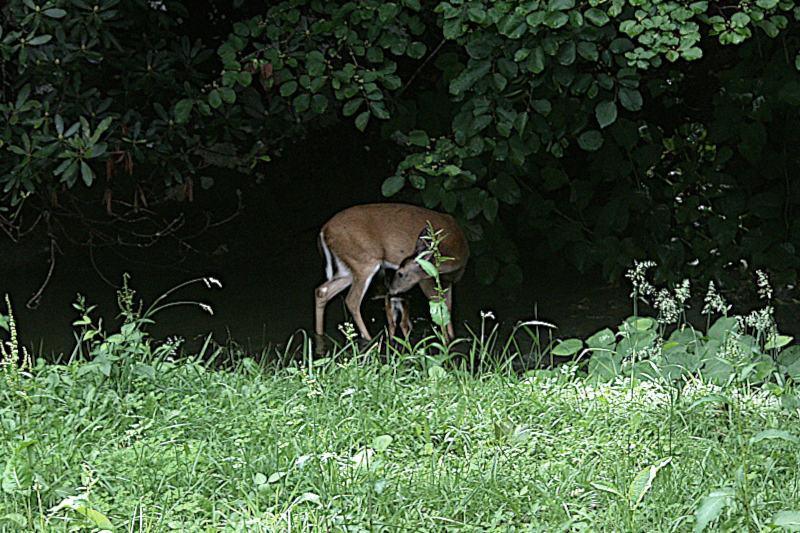
Whitetail doe and her newborn fawn on Walnut Creek, June 18, 2025. |
|
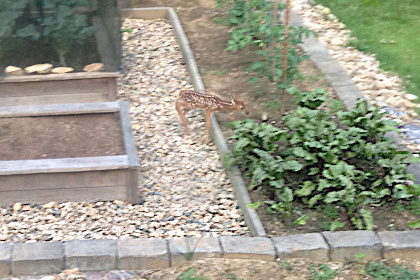
When I saw this little fawn exploring the garden, I didn't know what to make of it at first. When I stepped out onto the porch, it didn't seem frightened, but scampered about almost like it was playing, and then went underneath a large bush and stayed still. It seemed much too small and even a bit ungainly to be wandering about on it's own. Then I remembered that a doe had been hovering around for the last couple days, acting strangely, watching me from the creek bank, but never coming up to browse as deer usually do. I guessed that it might be her fawn and it had wandered off from wherever it had been hidden, which fawns will sometimes do. |
|
|
|
I knew the best thing to do was to leave the fawn alone and stay out of the way as best I could. I didn't see the doe again until the next day when I noticed her staring at me again from the creek. I stopped working, turned the shop lights out, and watched from my workbench. The doe finally came up from the creek, glancing over toward me often. She didn't go far when she began nosing about in a patch of high grass, and the fawn stood up beneath her. She fussed over it for a while, licking repeatedly and then led it to the creek, where she fussed and licked some more. That's when I took the photograph at the top of the page. |
|
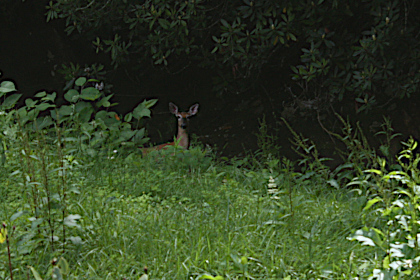
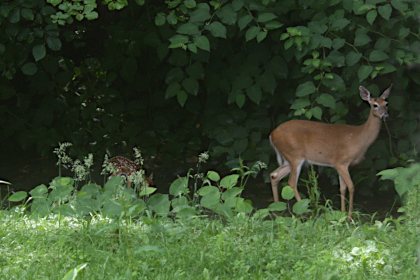
They lingered in Walnut Creek for a short time while the doe kept an eye on me and the fawn explored the water. For the first few weeks after birth, a doe leaves the fawn hidden in vegetation or tall grass and returns only a few times a day to feed it thus avoiding the attention of predators. The white spots on a fawn, which can number three hundred or more, provide camouflage, allowing it to blend into the dappled light and shadows of high grass or a forest floor. This adaption allows for newborns to be less visible to predators while their mother is away foraging. |
|
|
|
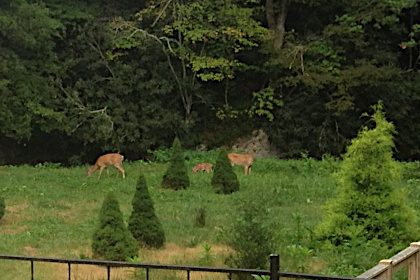
The doe eventually led the fawn into the woods on the other side of the creek, and I worried that my presence might have finally scared her off. But a week later they returned to browse, and afterwards, along with another deer, the doe and fawn appeared fairly often throughout the summer. The last time I saw them, the fawn was about three months old, and losing the spots that were once so distinctive. The other doe was with them again, perhaps a fawn from another year, now part of a family group. I've read that a doe will return to a spot she feels is safe to give birth, so perhaps I will see them all again in the spring. |
|
|