|
|

|
|
|
|



|
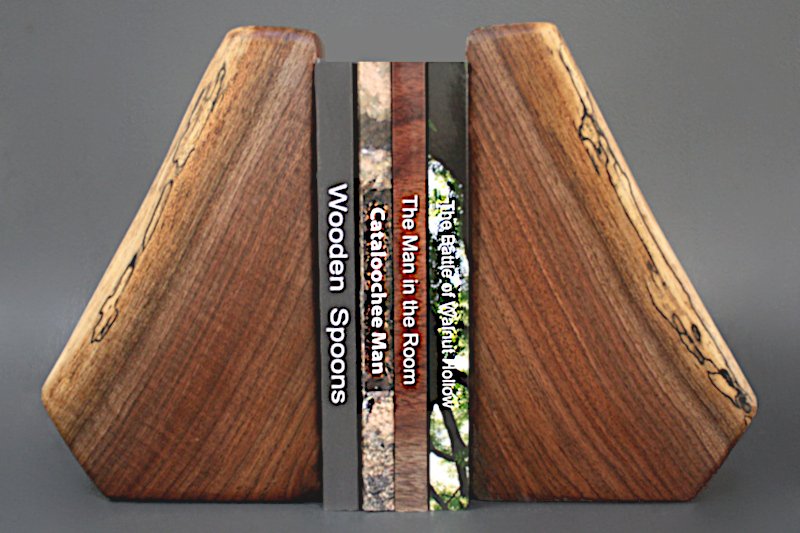
Image of Four Novels Displayed Between Walnut Bookends |
|
A word about the bookends that display my novels in the gallery and seem to get as much attention as the novels themselves. They were both carved from the same piece of wood and that was cut off the log from which Bird of Prey was created. Each piece is three and a half inches wide, and if you can imagine them joined together and turned up side down, then try to picture them as a solid, triangular peice that was cut from behind what's now the bird's head and shoulders. In fact it was the first piece removed from the log when I began that sculpture. The bottom of the bookends was the end of the log, and the lighter band on the outer edges is the sapwood once located on the outside of the log, just beneath the bark. |
|
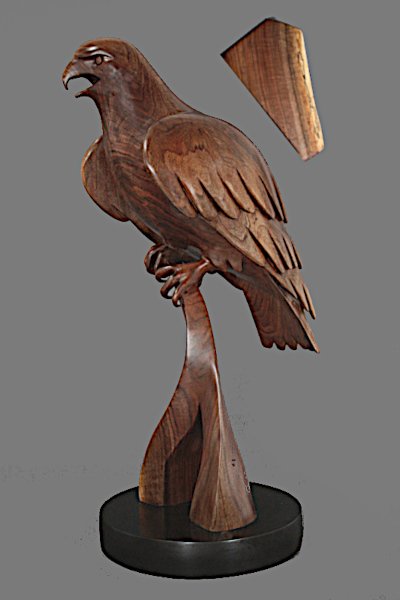
The image to the right roughly suggests where the wood for the Bookends Sculpture originated, although you probably still need to use your imagination a bit to see that. The log sat under cover for six years before I used it and the ends were fairly well cracked. I had to cut about three inches off above the hawk's head before I got beneath them. With the piece that became Bookends, I left the cracks because they would not be noticed on the bottom and I wanted as much weight as possible. I cut the piece vertically along the grain and down its thickness, which is called resawing. Then the pieces were opened like a book, such that the internal faces that were once joined together formed a symmetrical design, the grain patterns and color variations on one side reflect the other side. The obvious exception to this are the irregular black lines in the sapwood, which are part of a process called spalting, caused by fungi. The lines are so random and eratic that even the small separation caused by cutting and sanding resulted in different patterns on the two halves. Since I am a fan of spalted wood, I opted to leave it and allow the fungi to express themselves. The process of cutting wood in this way results in what is known as bookmatched lumber , which I thought was the appropriate technique to employ for creating wooden bookends. |
|
|
|
|
|